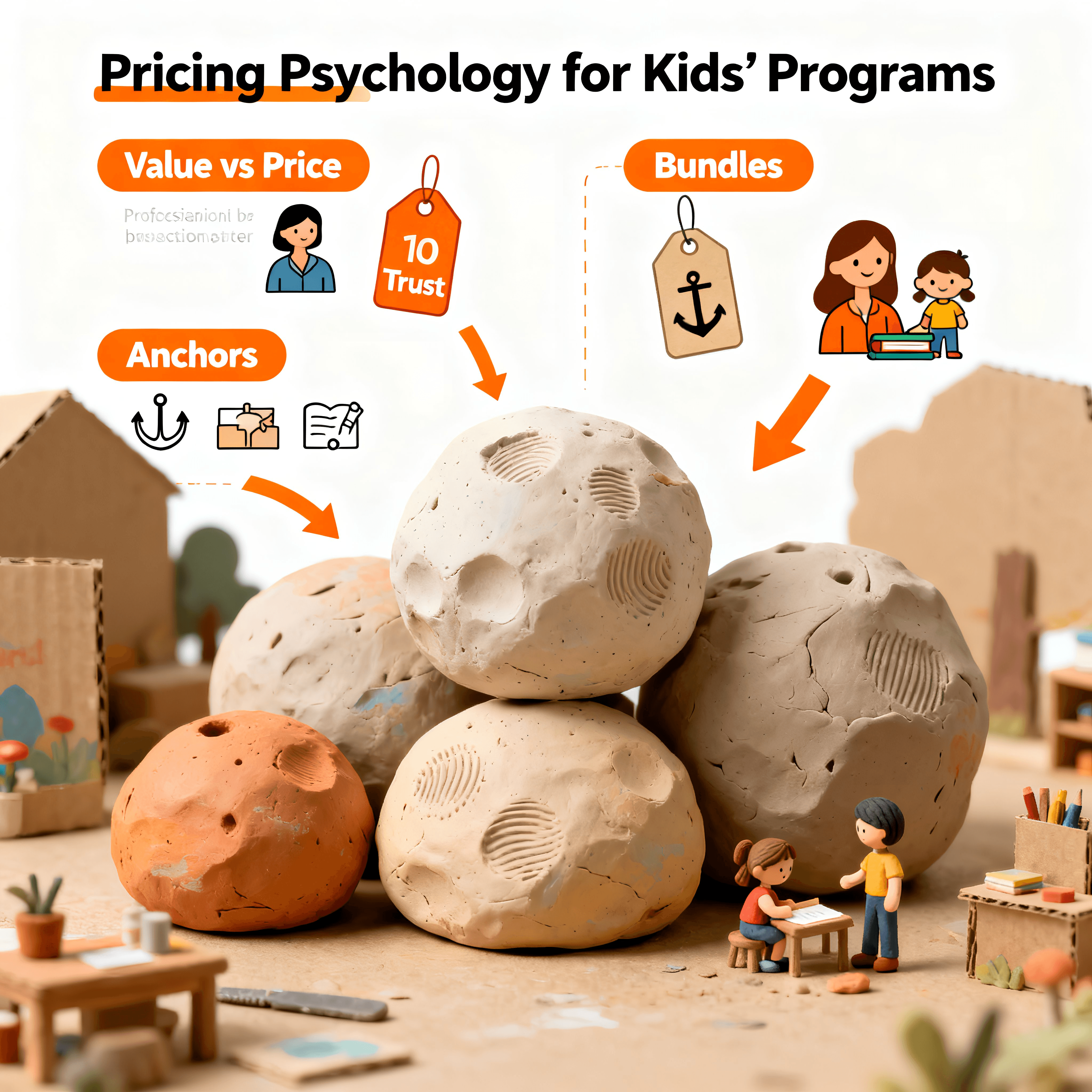
Pricing Psychology for Kids’ Programs

bdd

Feb 19, 2026
Why Parents Don’t Choose the Cheapest Camp or Class
Many education businesses assume lower prices drive enrolments.
In reality, parents in Singapore and across Asia rarely choose enrichment classes or camps based on price alone.
In 2026, pricing works psychologically — not mathematically.
This article explains how parents actually evaluate price for kids’ programs, and what education brands must understand to position their fees effectively.
1. Parents Evaluate Value, Not Cost
When parents see a price, their internal question is not:
“Is this cheap?”
It is:
“Is this worth my child’s time?”
They compare against:
staying home
screen time
other activities
other centres
If perceived value is high, higher prices feel justified.
If perceived value is unclear, even low prices feel expensive.
Key principle:
Clarity increases perceived value more than discounts.
2. Price Signals Quality in Education
In children’s programs, price acts as a quality signal.
Parents often interpret:
Very low price → risk or low quality
Mid price → acceptable
Premium price → trusted, structured, professional
This is especially true for:
camps
STEM programs
enrichment classes
Education is not retail — it involves trust and safety.
3. Discounts Can Reduce Trust
Heavy or constant discounts create unintended signals:
“Why is this always discounted?”
“Is demand weak?”
“Is quality lower?”
Short-term sales may increase bookings,
but long-term they weaken brand positioning.
Better approach:
early-bird pricing
limited slots
seasonal windows
bundles
These maintain value while reducing hesitation.
4. Parents Prefer Structured Pricing
Parents feel more comfortable when pricing feels organised and predictable.
High-converting structures:
✔ weekly fee
✔ term fee
✔ camp bundle
✔ sibling pricing
✔ voucher credits
Confusing structures reduce enrolment confidence.
5. Anchoring Shapes Perception
Parents rarely evaluate a price in isolation.
They compare it to a reference point (anchor).
Examples:
Show premium camp → standard camp feels reasonable
Show weekly → daily feels small
Show term → monthly feels manageable
Without anchors, prices feel larger.
6. Friction Matters More Than Amount
Sometimes the barrier isn’t the price — it’s the effort.
Parents hesitate when:
booking is complex
schedule unclear
commitment feels rigid
refund unclear
Reducing friction increases enrolments without lowering price.
7. Parents Buy Outcomes, Not Hours
A common mistake is presenting price as time:
“5-day camp”
Parents evaluate impact:
confidence
skills
engagement
development
When outcomes are clear, price resistance drops.
8. Premium Positioning Requires Explanation
Higher-priced programs must clearly show:
structure
safety
expertise
benefits
Without explanation, premium looks expensive.
With explanation, premium looks justified.
9. Bundles Reduce Psychological Risk
Parents fear committing to unknown experiences.
Bundles help because they:
lower perceived cost per session
spread commitment
create saving logic
This is why camp vouchers work strongly in Asia markets.
10. The Winning Principle: Price Must Feel Logical
Parents accept higher prices when they feel:
✔ clear
✔ structured
✔ justified
✔ consistent with brand
They resist prices that feel random or unexplained.
Final Thoughts
In 2026, education pricing success is not about being cheaper.
It is about being clearer, more structured and more trustworthy.
Education brands that position price through value, anchors and structure convert more families — even at higher fees.
Those that rely on discounts compete in a race to the bottom.
Kate M